مقدمة
Buying a pan sounds simple until you actually try to choose one. You search online, open a few product pages, and suddenly you’re comparing coatings, metal layers, heat ratings, and dozens of reviews arguing back and forth about non stick vs stainless steel cookware. One person says non stick saves time. Another says stainless steel lasts forever. Some warn about health concerns. Others talk about “professional results.” The problem is not a lack of information. It’s too much conflicting information.If you’re a home cook, you probably just want something that cooks well and doesn’t waste money.
If you’re running a café, restaurant, Airbnb, or hotel kitchen, you care about durability, replacement cost, and long-term value even more.
In both cases, choosing the wrong type of pan creates daily frustration:
- food sticks when it shouldn’t
- coatings wear out too fast
- cleaning takes too long
- or you end up replacing pans every year
That’s why understanding non stick vs stainless steel cookware is less about preference and more about matching the tool to how you actually cook.This guide walks you through the differences step by step, using real-life cooking scenarios instead of marketing claims, so you can make a practical and confident decision.
1. Material Fundamentals: How Each Pan Is Built and Why It Matters
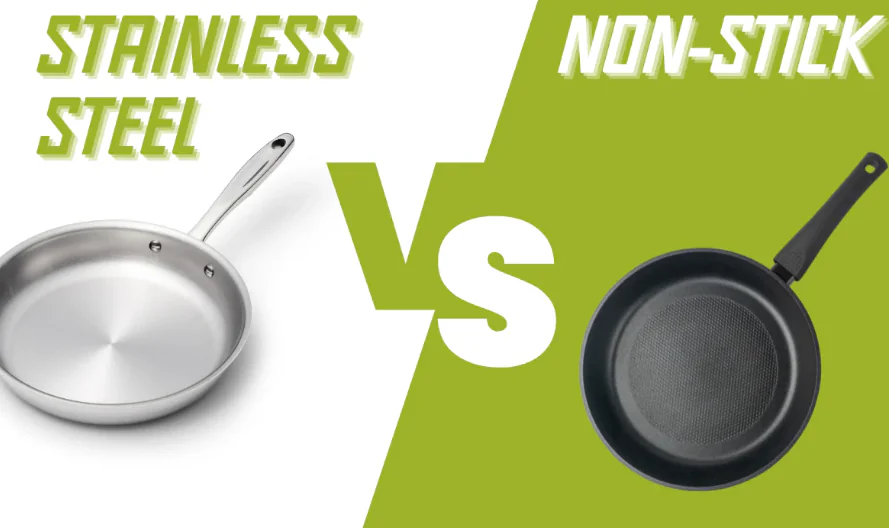
Before comparing performance, you need to understand the basic structure. The difference between non stick vs stainless steel starts at the material level.
These two pans are engineered in completely different ways, and those design choices directly affect durability, cooking style, and maintenance.
1.1 Non-stick construction
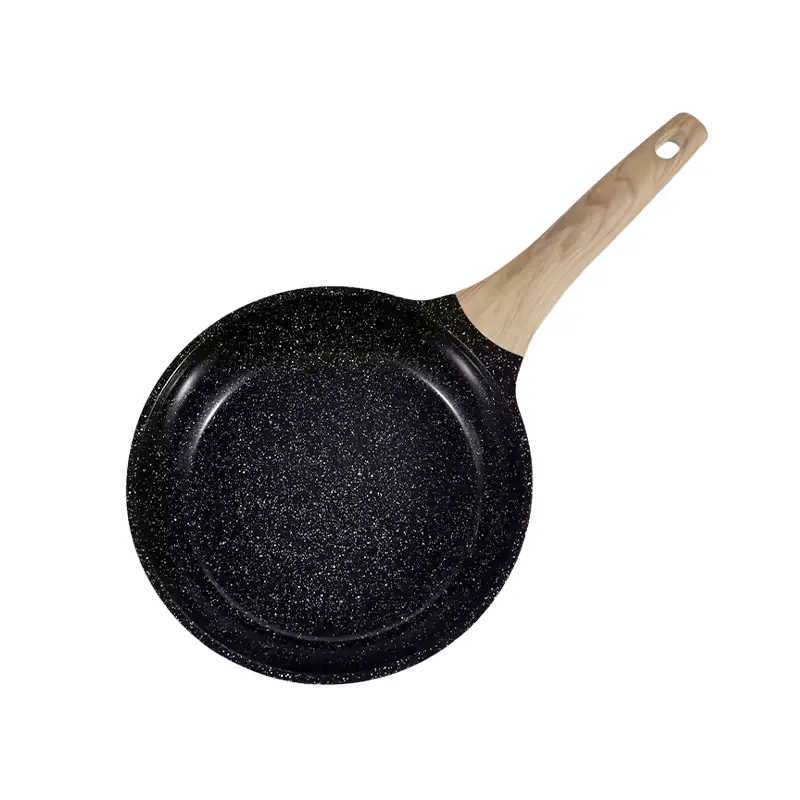
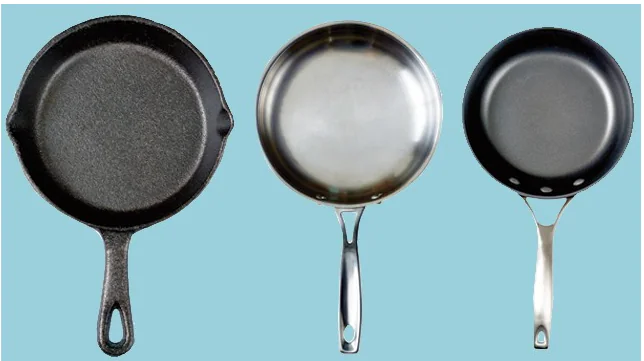
Most non-stick pans use an aluminum base with a coated interior surface.
Aluminum heats quickly and keeps the pan lightweight.
On top of that, manufacturers add a synthetic layer such as PTFE or ceramic.This layer creates a very smooth surface. Food cannot easily bond to it, which is why eggs slide and pancakes flip without effort.
From a user perspective, it feels forgiving. Even if your heat control is not perfect, food usually doesn’t stick.
That’s why many beginners immediately prefer non stick or stainless steel for everyday cooking and choose non-stick. It reduces the chance of mistakes.
However, this same coating is also the weak point. Every time you cook, wash, or scrub, the surface slowly wears down. Once damaged, the performance drops quickly.
1.2 Stainless steel construction
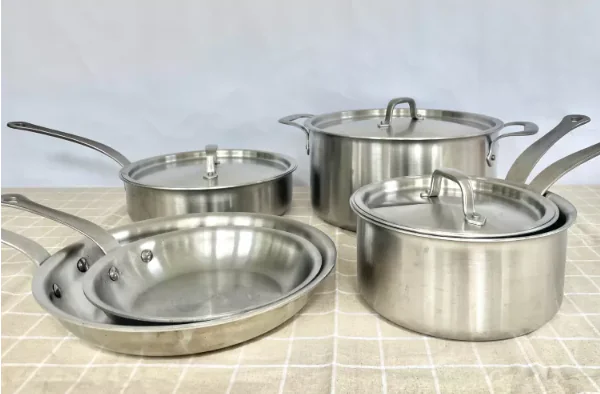
Stainless steel cookware takes the opposite approach.There is no coating at all.Instead, you typically get multiple bonded layers: stainless steel on the outside and aluminum or copper in the core for heat distribution.This layered design improves strength and stability. You’re cooking directly on metal rather than on a chemical surface.Because nothing can peel or chip, the pan structure stays intact for many years.But stainless steel doesn’t prevent sticking automatically. You rely on proper technique: preheating, enough oil, and patience. So the difference between non stick vs stainless steel is really convenience versus robustness.
2. Daily Cooking Experience: What You Notice During Real Meals
Most buying guides talk about specifications. But specs don’t matter when you’re hungry at 7 p.m. and just want dinner ready fast.
What matters is how the pan behaves in everyday situations.
2.1 Cooking with non-stick at home
Imagine making breakfast before work.
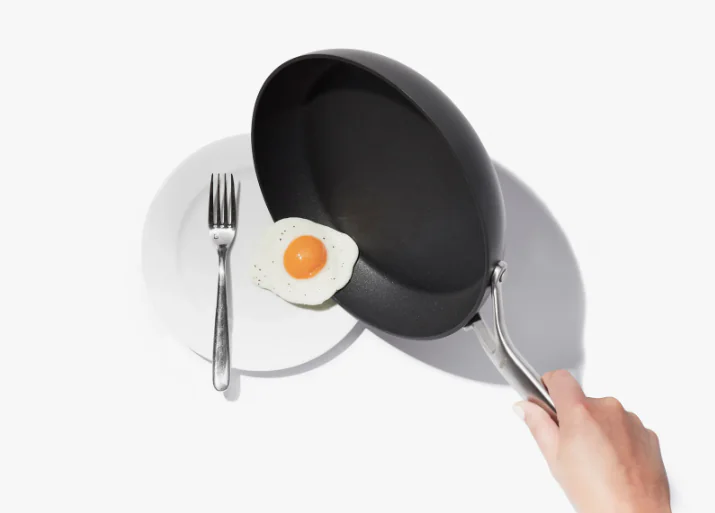
You crack two eggs into the pan. No sticking. No scraping. Cleanup takes 15 seconds.
This is where non-stick shines. For quick, low-oil cooking, it saves time every single day.
It works especially well for:
- eggs and omelets
- pancakes and crepes
- delicate fish
- reheating leftovers
- light sautéing
If your cooking style looks like this most days, non stick or stainless steel for everyday cooking becomes an easy decision. When talking about non stick vs stainless steel, non-stick simply feels more convenient.
2.2 Cooking with stainless steel at home
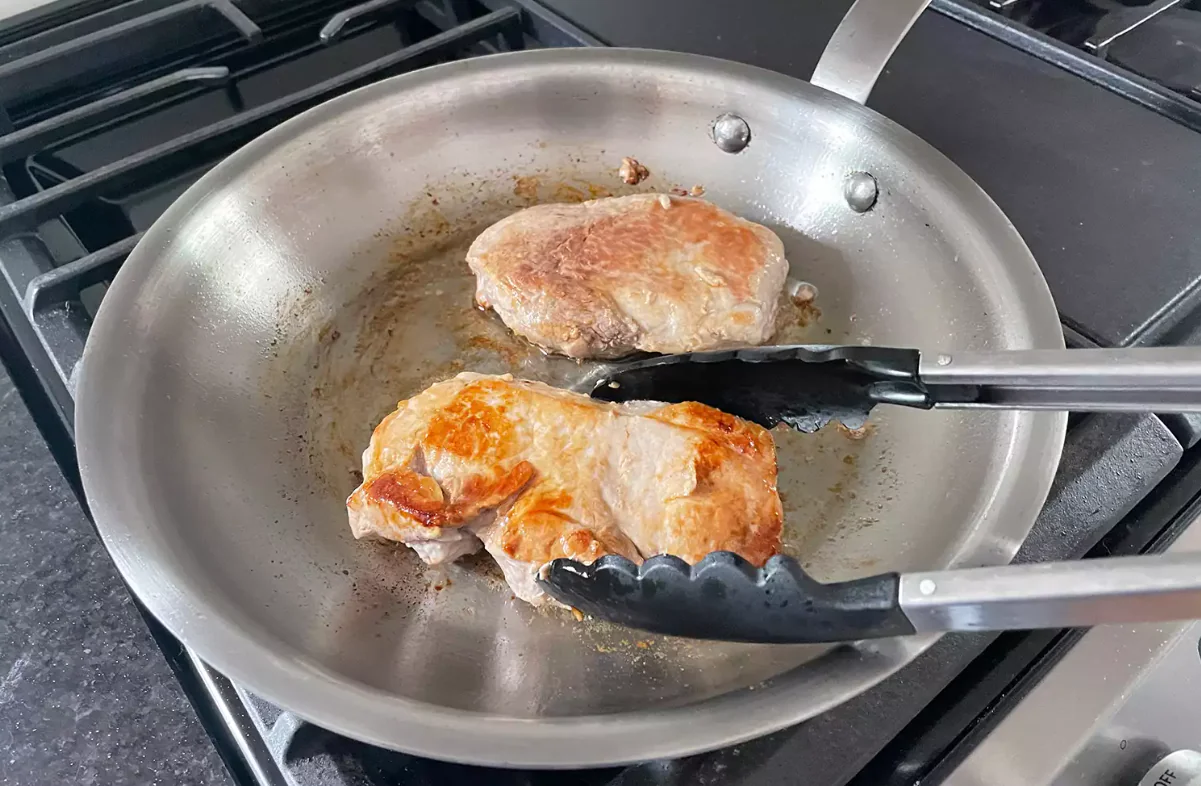
Now imagine cooking a steak or chicken thigh.You want a golden crust and deep flavor.This is where stainless steel performs better.Once properly preheated, stainless steel allows meat to brown naturally. The caramelized bits left in the pan help you build sauces with richer taste.Many people who switch from non-stick to stainless steel notice their food tastes more “restaurant-style.”So when asking is stainless steel better than non stick, the answer depends on what you’re cooking.For speed and simplicity, non-stick wins. For flavor and technique, stainless steel often wins.
3. Heat Performance and Cooking Control
Heat control determines cooking quality more than any other factor. And this is where non stick vs stainless steel cookware shows clear differences.
3.1 High-heat cooking
Non-stick coatings don’t like extreme temperatures. Prolonged high heat shortens their lifespan. If you frequently cook above medium-high heat, you may notice discoloration or reduced non-stick performance within months. Stainless steel, on the other hand, tolerates very high heat without damage.
You can:
- sear steak
- stir-fry vegetables
- finish dishes in the oven
- deglaze with wine or vinegar
without worrying about harming the surface. This makes stainless steel more flexible, especially for serious home cooks and professional kitchens when talking about non stick vs stainless steel.
3.2 Browning and flavor development
Flavor comes from browning.
Stainless steel creates better browning because food makes direct contact with metal. This produces fond, which enhances sauces and gravies.
Non-stick reduces fond formation.
Food cooks, but you don’t get the same depth of flavor.
This is one of the most overlooked points in the non stick vs stainless steel pros and cons discussion. Convenience sometimes comes at the cost of taste.
4. Cleaning, Care, and Time Investment
Convenience isn’t just about cooking. Cleaning matters too.
4.1 Non-stick cleaning routine
Most days, you just wipe and rinse.
It’s fast and low effort.
But you must also:
- avoid metal utensils
- avoid rough scrubbers
- avoid stacking roughly
- avoid overheating
In other words, you must treat it gently.
4.2 Stainless steel cleaning routine
Stainless steel may require scrubbing sometimes. Burnt residue happens. But you don’t need to baby it. You can scrub hard, use steel wool, or even boil water to clean it. It’s tougher.
So the trade-off becomes clear: Non-stick saves time today. Stainless steel saves money long term.That trade-off is central to any realistic non stick vs stainless steel cookware decision.
5. Health and Safety Perspective
Health concerns often influence buyers more than performance.
People frequently search for non stick vs stainless steel health or which pan is healthier.
Here’s the practical view.
Modern non-stick is generally safe under normal conditions. But overheating or damaged coatings can create worries.
Stainless steel contains no coating and remains stable at all cooking temperatures.
So if you prefer fewer variables and less maintenance, stainless steel offers more peace of mind.
This is one reason many families and commercial kitchens lean toward stainless when safety is the priority.
6. Side-by-Side Comparison: Pros and Cons You Can See at a Glance
After understanding materials and daily experience, you now need something more concrete.
Because when you actually buy, you don’t think in theory.
You think in trade-offs.What do you gain?
What do you lose?That’s where a structured comparison helps clarify the real non stick vs stainless steel pros and cons.
Instead of broad claims, let’s evaluate from five practical dimensions: ease of use, cooking results, lifespan, maintenance, and cost.
6.1 Ease of use
Non-stick clearly wins here.
You don’t need special skills. You don’t need temperature control knowledge. Even beginners can cook eggs or pancakes successfully on day one.
Stainless steel requires learning.
If you skip preheating or use too little oil, food sticks. Many people try it once, fail, and assume stainless steel is “bad.” In reality, it’s technique-dependent.
So if you want a zero-learning-curve tool, non-stick feels friendlier.
6.2 Cooking performance
This is where stainless steel pulls ahead.
You get:
- better browning
- stronger searing
- more stable heat
- oven compatibility
- sauce building (deglazing)
Non-stick limits you to medium or lower heat and doesn’t create fond easily.
If flavor matters to you, or you cook proteins frequently, the performance gap becomes obvious.
This is why professional kitchens rarely debate non stick vs stainless steel cookware. Stainless steel is simply more versatile for serious cooking.
6.3 Lifespan
Here the difference is dramatic.
Average lifespan estimates:
Non-stick:
- light home use: 2–3 years
- daily use: 1–2 years
- commercial use: less than 1 year
Stainless steel:
- home use: 10–20 years
- commercial use: 5–10+ years
This huge gap is the core of the stainless steel vs non stick durability discussion.
If you dislike replacing tools frequently, stainless steel immediately becomes more attractive.
6.4 Maintenance effort
Non-stick:
- quick cleaning
- but must be handled carefully
Stainless steel:
- sometimes harder to clean
- but extremely tough and forgiving
So you choose between gentle daily care or occasional heavier cleaning.
6.5 Long-term value
When people compare prices in stores, they often see:
Non-stick: $20–$40
Stainless steel: $70–$120
At first glance, non-stick looks cheaper.
But price alone is misleading. Value depends on how long it lasts.
And this leads directly into the next section.
7. Real Cost Analysis: Which One Actually Saves You Money?
Many buyers focus too much on the price tag and ignore replacement frequency.
Let’s do simple math using realistic numbers about non stick vs stainless steel
7.1 Home kitchen example
Imagine you cook almost daily.
Scenario A: Non-stick
$30 per pan × replace every 18 months
Over 9 years = 6 pans
Total = $180Scenario B: Stainless steel
$90 one time
Lasts 9–10 years or more
Total = $90That’s half the cost.
Even if stainless steel costs three times more upfront, it often costs less over time.
So when someone asks is stainless steel better than non stick financially, the answer is often yes if you think long term.
7.2 Restaurant or café example
Now imagine you manage a small café and need 40 pans.
Non-stick:
$25 × 40 = $1,000
Replace yearly = $1,000 per yearOver 5 years = $5,000
Stainless steel:
$85 × 40 = $3,400
Lasts 5+ yearsTotal ≈ $3,400
Plus fewer replacements, less downtime, and less operational hassle.
For business owners, this difference isn’t small. It directly affects margins.
This is why many B2B buyers who initially search non stick or stainless steel for everyday cooking eventually standardize on stainless steel for durability reasons.
8. Durability Testing: What Happens After One Year of Use?
Durability isn’t just about time. It’s about how the pan behaves after repeated stress.
Let’s look at what typically happens in real kitchens.
8.1 Non-stick wear patterns
After months of use, you may notice:
- small scratches
- dull spots
- reduced slipperiness
- food sticking more often
- coating discoloration
Once the coating degrades, performance drops quickly.
You can’t “repair” it. Replacement is the only solution.
8.2 Stainless steel aging patterns
After months or years, stainless steel usually shows:
- surface discoloration
- minor scratches
- heat stains
But performance stays almost the same.
Even a 10-year-old stainless steel pan can cook like new.
Functionally, it doesn’t degrade much.
This practical difference explains why stainless steel vs non stick durability is such a key consideration for hotels, rental kitchens, and catering companies.
They care about tools that survive heavy use, not tools that look pretty at first.
9. Health, Safety, and Peace of Mind
Even if performance and cost make sense, many people still hesitate because of health concerns.
Search trends show that questions like non stick vs stainless steel health and which pan is healthier appear frequently.
So let’s address this directly.
9.1 Non-stick considerations
Modern coatings are generally safe when used correctly.
But you must:
- avoid overheating
- avoid scratches
- avoid old damaged pans
Once the surface peels or chips, most people prefer to replace it.
For some users, this uncertainty creates stress.
9.2 Stainless steel considerations
Stainless steel has no coating to degrade.
It doesn’t react easily with food and handles high heat without releasing anything unusual.
From a purely material standpoint, it’s one of the most stable cookware options available.
So if you prefer fewer “rules” and fewer worries, stainless steel often feels safer psychologically as well as physically.
That’s why many families choose it when thinking about non stick vs stainless steel cookware for long-term use.
10. Decision Framework: How You Should Actually Choose
Instead of arguing which is “better,” a smarter question is:
Which fits your situation better?
Here’s a simple framework you can use.
Choose non-stick if you:
- cook quick breakfasts often
- prioritize easy cleaning
- prefer lightweight pans
- don’t mind replacing periodically
- want something beginner-friendly
Choose stainless steel if you:
- cook meat frequently
- like better browning
- want long-term durability
- prefer fewer replacements
- run a commercial or shared kitchen
- buy in bulk
Choose both if possible
Many experienced cooks keep:
1 non-stick for delicate food
1 stainless steel for everything elseThis hybrid setup often eliminates the entire non stick vs stainless steel debate because each pan does what it’s best at.
11. Practical Usage Skills: How to Cook Better With Both Types of Pans
Choosing the right pan is only half the story.
Even the best cookware performs poorly if you use it the wrong way.
Many frustrations people blame on materials are actually technique issues. Someone buys stainless steel, food sticks once, and they immediately conclude non-stick is better. Others buy non-stick, overheat it daily, and complain it only lasts six months.
In reality, both pans work well when you understand how they’re meant to be used.
If you learn a few simple habits, the whole non stick vs stainless steel cookware debate becomes much less dramatic.
11.1.Using stainless steel correctly
Stainless steel doesn’t have a protective coating, so you rely on heat and oil to create a temporary barrier between food and metal.
The key is preheating.
Place the empty pan on the stove first. Give it one or two minutes. Then add a few drops of water. If the droplets bead up and glide across the surface, the temperature is right. Only then add oil and food.
This small step changes everything.
Food that used to stick suddenly releases naturally.
You also need a bit more patience. When cooking meat or fish, don’t flip too early. Let it brown fully. Once the crust forms, the food separates from the pan on its own.
Many home cooks are surprised how smooth stainless steel feels after mastering this technique. At that point, the question of non stick or stainless steel for everyday cooking becomes less about fear of sticking and more about cooking style.
11.2.Using non-stick correctly
Non-stick, on the other hand, requires less technique but more care.
The biggest mistake people make is using high heat.
High temperatures don’t cook food much faster, but they break down coatings quickly. If you keep heat at medium or below, the surface lasts much longer.
Utensils matter too. Metal tools slowly scratch the coating even if you can’t see it. Switching to silicone or wood often doubles the lifespan.
Another overlooked habit is washing a hot pan immediately. Sudden temperature change stresses both the metal and the coating. Let it cool first, then clean gently.
These small adjustments can easily add an extra year of life.
So when evaluating non stick vs stainless steel pros and cons, remember that maintenance habits directly affect durability.
12. Matching the Pan to Your Cooking Style and Daily Needs
Instead of asking which pan is “better,” a more useful question is: which one fits how you actually cook?
Your daily routine matters more than material science.
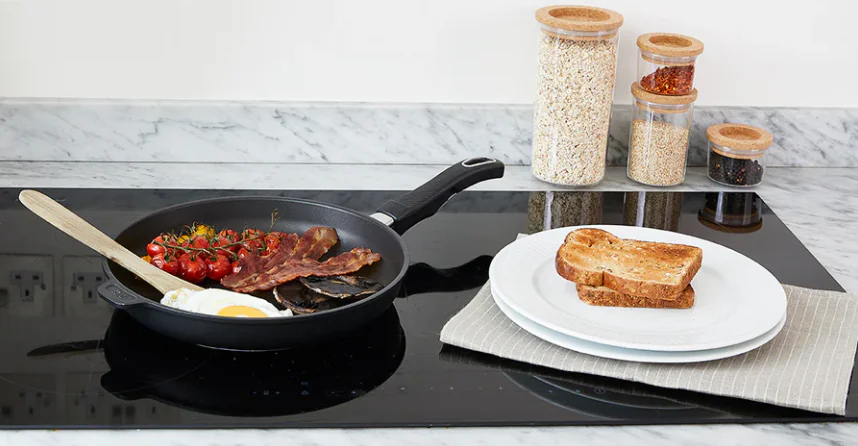
If you cook quick meals before work, reheat leftovers, or make simple breakfasts, convenience probably matters most. You want something fast, light, and easy to clean. In these situations, non-stick feels natural. It reduces friction, both literally and mentally. You don’t worry about technique. You just cook and move on.
This is why many households instinctively choose non-stick when considering non stick or stainless steel for everyday cooking.
But if you enjoy cooking as a hobby, the priorities change.
Maybe you sear steak on weekends. Maybe you build pan sauces, try new recipes, or care about texture and browning. Stainless steel gives you more control here. You can cook hotter, develop deeper flavor, and use the same pan on the stovetop and in the oven.
The results often taste better, not because stainless steel is magic, but because it allows proper caramelization.
This is also where people start asking is stainless steel better than non stick. For flavor development and versatility, many experienced cooks would say yes.
Health considerations sometimes influence the decision too. If you worry about coatings or long-term wear, stainless steel provides peace of mind because it has no synthetic surface. That’s why searches like non stick vs stainless steel health or which pan is healthier are increasingly common. From a stability standpoint, stainless steel is simply more inert and predictable.
So the answer changes depending on what you value most: speed, flavor, or longevity.
13. Long-Term Value and Buying Strategy for Homes and Businesses
Once you step back and look beyond daily cooking, the conversation becomes financial.
Cookware is not just a tool. It’s an investment.
For home kitchens, the cost difference might feel small at first. A non-stick pan costs less upfront, which seems like a good deal. But if you replace it every year or two, the total expense quietly adds up.
Stainless steel costs more initially but can last ten years or more with minimal performance loss. Over time, it often becomes the cheaper option.
This is why stainless steel vs non stick durability is not just about toughness. It directly affects your wallet.
For businesses, the impact multiplies.
Imagine a small restaurant using 40 or 50 pans daily. If non-stick needs replacing every year, that means constant reordering, inventory checks, and wasted labor. Staff must adapt to new pans repeatedly. Costs become unpredictable.
Stainless steel simplifies operations. You buy once and use them for years. Fewer replacements mean fewer disruptions.
That’s why many cafés, hotels, and catering companies standardize stainless steel as their primary cookware when comparing non stick vs stainless steel cookware for bulk purchases. Non-stick may still exist for eggs or delicate foods, but it’s rarely the main workhorse.
Interestingly, many experienced kitchens eventually adopt a hybrid system.
They keep one or two non-stick pans for specific tasks and rely on stainless steel for everything else.
This balanced approach often solves the entire debate. Instead of choosing sides, you use each pan where it performs best.
From a practical standpoint, this strategy gives you convenience, durability, and better cooking results all at once.
14. Final Comparison and Decision Framework
After examining performance, durability, safety, maintenance, and real-life usage, it becomes clear that the debate around non stick vs stainless steel is not about superiority, but about suitability.
Both materials were designed to solve different problems. Non-stick exists to reduce friction and simplify cooking. Stainless steel exists to maximize control and longevity.When you understand this difference, the choice becomes logical rather than emotional. If your priority is speed and convenience, non-stick naturally feels better. It heats quickly, releases food effortlessly, and cleans with minimal effort. For people with busy schedules or limited cooking experience, this ease of use removes many barriers. You don’t need special techniques or temperature management. Breakfast becomes faster, cleanup becomes easier, and daily cooking feels less stressful.
However, convenience always comes with trade-offs. Coatings wear down. High heat shortens lifespan. Replacements become routine. Over several years, what seemed cheap initially may cost more overall.
Stainless steel, by contrast, asks for more skill at the beginning but rewards you with stability over time. Once you learn heat control and proper preheating, sticking becomes less of an issue. What you gain instead is better browning, stronger flavor development, oven compatibility, and near-permanent durability.
This is why many experienced cooks gradually migrate toward stainless steel. Not because non-stick fails, but because stainless steel simply offers fewer limitations.
Another way to think about the question is through time horizon. If you are buying a pan for short-term convenience, non-stick is practical. If you are building a kitchen for the next ten years, stainless steel makes more sense.Short-term ease versus long-term reliability — this is the real comparison hidden inside the non stick vs stainless steel cookware discussion.
15. Recommended Setup for Different Types of Users
Rather than forcing a single choice, most kitchens benefit from combining both materials strategically.
For home users, one or two small non-stick pans paired with one or two stainless steel pans often creates the most efficient setup. The non-stick handles eggs, pancakes, and delicate foods. Stainless steel handles meat, sauces, stir-fries, and oven cooking. This combination covers almost every scenario without compromise.
For families that cook frequently, leaning more heavily toward stainless steel reduces replacement costs and ensures consistent performance. Non-stick can still serve as a helpful backup, but it doesn’t need to be the main workhorse.
For professional kitchens or food businesses, stainless steel should usually form the foundation. Restaurants require durability, high heat tolerance, and predictable long-term costs. Replacing dozens of coated pans every year is inefficient both financially and operationally. That is why commercial kitchens rarely rely solely on non-stick surfaces.
For wholesalers, distributors, or bulk buyers, offering both options is often the smartest strategy. Retail markets still demand non-stick for convenience, while commercial clients prefer stainless steel for reliability. Understanding these different customer needs can help shape better product lines and purchasing plans.
In practice, the most successful kitchens do not ask “non stick or stainless steel.”
They ask “when should I use each one.”This shift in thinking usually eliminates the debate entirely.
الخاتمة
In the end, cookware is not about finding a perfect material. It is about finding the right tool for the task.Non-stick simplifies everyday cooking and lowers the learning curve. It is friendly, fast, and practical for light tasks.Stainless steel offers strength, versatility, and longevity. It delivers better browning, withstands higher temperatures, and often lasts for decades.
Neither replaces the other completely.Understanding the strengths and limits of each helps you cook more efficiently, spend money more wisely, and avoid unnecessary frustration.So when you next stand in front of the cookware shelf wondering about non stick vs stainless steel, the answer is simple.
Choose non-stick for convenience.
Choose stainless steel for performance.
Choose both if you want the best overall kitchen experience.
The smartest kitchens are not built on one material — they are built on balance.

تتمتع جانيس بسنوات من الخبرة المتفانية في صناعة أدوات المطبخ، مع التركيز على حل تحديات المشتريات التي تواجه المشترين. كما أنها تدير الامتثال من البداية إلى النهاية حتى يتمكن المشترون من تجنب التأخير. هدفها هو أن تكون حليفتك الموثوقة في مجال أدوات المطبخ - تقديم منتجات عالية الجودة في الوقت المحدد، دون أي مشاكل.