


If you are a distributor filling a container, a retailer building a house brand, or a procurement manager stocking a restaurant chain, you have asked this question more than once: aluminum or stainless steel? You know the price difference. You have seen both sell. But when a buyer asks you which material actually belongs in their kitchen — and why — the answer is never as clean as a catalog page makes it look.
This article is for the people whose margins and reputations depend on getting that answer right. No brand fluff. No “it depends” and walk away. Just the physics, the trade-offs, and the sourcing logic that separates a stockpot your customers love from one they return.
Aluminum vs. Stainless Steel: The Core Physics That Drive Performance
Before we talk about cost or durability, we need to talk about what happens when you put a stockpot on a burner. The two materials behave fundamentally differently — and that difference starts at the atomic level.
Thermal Conductivity: Why Aluminum Heats Faster
Aluminum has a thermal conductivity of approximately 237 W/m·K. Stainless steel? Roughly 15 W/m·K — about fifteen times lower. In practical terms, this means an aluminum stockpot transmits heat from the burner to the liquid inside dramatically faster. A 40-quart aluminum pot will bring 30 quarts of water to a rolling boil noticeably sooner than its stainless steel equivalent, and it will respond more quickly when you lower the flame for a gentle simmer.
This isn’t just about speed — it is about control. Aluminum’s high conductivity means heat spreads laterally across the base and up the sidewalls more evenly. You get fewer hot spots. You get less scorching on the bottom of a thick stock or chowder. For a busy commercial kitchen that needs to fire, boil, and hold temperatures throughout a shift, that responsiveness translates into real operational efficiency.
How Tri-Ply Stainless Steel Closes the Gap
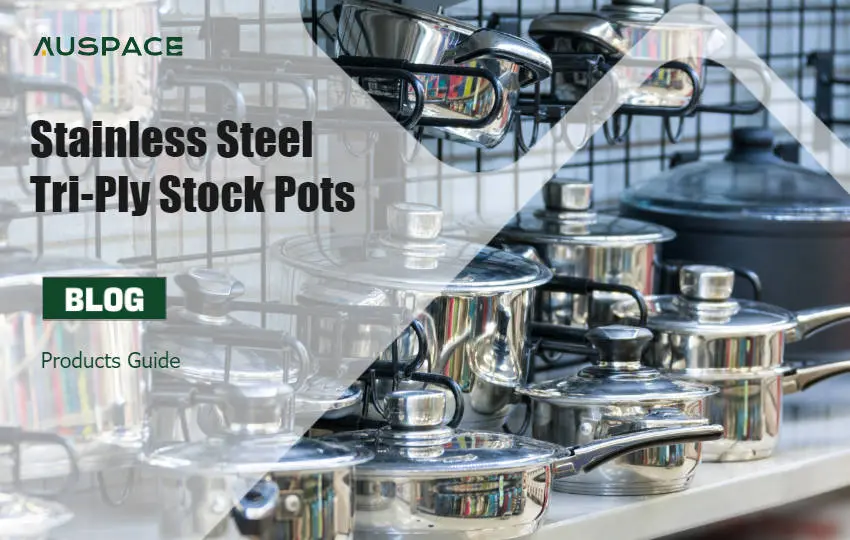
Pure stainless steel is a poor heat conductor — the industry knows this. That is why any heavy-duty stainless steel stockpot worth sourcing uses tri-ply or multi-ply construction: a core layer of aluminum (or sometimes copper) sandwiched between two layers of stainless steel. The aluminum core carries the heat; the stainless steel exterior provides strength, non-reactivity, and that signature polished look.
Does tri-ply match pure aluminum’s conductivity? No. But it narrows the gap significantly — a well-made tri-ply pot performs within striking distance of aluminum while adding durability and chemical inertness that aluminum alone cannot offer. When evaluating samples, pay attention to how thick that middle aluminum core is. A thin, token aluminum layer won’t fix the problem; a substantial 1.5–2.5 mm core will.
Density and Weight: The 3× Rule
Aluminum has a density of about 2.7 g/cm³. Stainless steel sits at roughly 8.0 g/cm³ — nearly three times heavier for the same volume. This is the single most overlooked variable in B2B stockpot sourcing. A 60-quart stainless steel stockpot, full of water, can weigh over 80 pounds. Two kitchen staff need to carry it. Aluminum cuts that burden dramatically.
Weight matters for more than ergonomics. It affects shipping costs per unit. It affects retail shelf weight limits. It affects the end-user’s willingness to pull the pot out of a cabinet in the first place. If your distribution channel is catering supply, institutional food service, or any market where users move pots frequently, weight is not a footnote — it is a primary buying criterion.
Side-by-Side: 6 Dimensions That Matter for Heavy-Duty Use
Below is a direct comparison across the six dimensions that influence real-world performance and B2B buyer decisions. Each rating assumes heavy-gauge, quality construction on both sides — not entry-level products.
| Dimension | ألومنيوم | Stainless Steel (Tri-Ply) | What It Means for Sourcing |
| Heat Efficiency | ★★★★★ | ★★★☆☆ | Aluminum reduces energy costs and speeds up batch turnover in high-volume kitchens. |
| Weight | ★★★★★ | ★★☆☆☆ | A full 40 qt aluminum pot is manageable by one person; stainless steel often requires two. |
| Lifespan | ★★★☆☆ | ★★★★★ | Stainless steel is a 10–20 year asset with proper care; aluminum is more of a 3–7 year workhorse. |
| Acid Resistance | ★★☆☆☆ | ★★★★★ | Bare aluminum reacts with tomatoes, vinegar, and wine; stainless steel is chemically inert. Hard-anodized aluminum solves this. |
| Cooktop Compatibility | ★★★☆☆ | ★★★★★ | Stainless steel works on all cooktops by default. Aluminum needs an encapsulated induction base for induction markets. |
| Unit Cost | ★★★★★ | ★★☆☆☆ | Aluminum costs 1/3 to 1/2 the wholesale price of equivalent tri-ply stainless steel. This impacts MOQ budgets and retail pricing strategy. |
Notice something important: no material wins every row. Aluminum dominates on heat, weight, and price. Stainless steel dominates on lifespan, chemical compatibility, and cooktop flexibility. The sourcing decision is about which two or three dimensions your buyers care about most.
When Aluminum Wins: The Right Tool for the Right Job
Aluminum stockpots excel in three specific sourcing scenarios. If any of these match your distribution profile, aluminum is likely your answer.
Scenario 1: High-Volume Catering and Banquet Operations
A catering kitchen might fire six 40-quart stockpots simultaneously — seafood boils, pasta water, soup bases — and move each pot from burner to prep table multiple times per shift. In this environment, speed and weight are non-negotiable. Aluminum heats faster, cools faster, and a single cook can carry a full pot across the kitchen without help. The shorter lifespan is acceptable because the cost-per-use is so low; replacing a $30 aluminum stockpot after four years of daily service is still an excellent return.
Scenario 2: Price-Sensitive Retail Channels
If your customers are discount retailers, mass-market department stores, or e-commerce platforms where sub-$50 price points drive conversion, aluminum gives you the margin structure to compete. A well-made 12-quart aluminum stockpot with a tempered glass lid and a decent non-stick coating can retail profitably at price points where stainless steel simply cannot reach. The key is not to compete on being “cheap” — compete on being a smart value with real heat-performance advantages.
Scenario 3: Oversized Batch Cooking
Once you cross the 60-quart threshold, stainless steel stockpots become genuinely difficult to handle. An 80-quart tri-ply pot full of corn-boiling water can exceed 100 pounds. Aluminum keeps these oversized vessels practical. For crawfish boils, large-scale canning, brewery wort production, and institutional soup kitchens, aluminum is often the only practical choice — regardless of budget.
Two caveats for aluminum buyers:
- If your end users regularly cook acidic foods (tomato sauces, pickling brine, wine reductions), specify hard-anodized aluminum or a non-stick interior coating. Bare aluminum will react and impart metallic notes.
- Source above 4 mm gauge for heavy-duty use. Thin, budget aluminum stockpots dent easily and develop hot spots — the material itself is not the problem; insufficient thickness is.
When Stainless Steel Wins: Investing in Longevity
Stainless steel stockpots command higher wholesale prices for good reasons. Here is where the premium pays off.
Scenario 1: Premium Retail and Hospitality
A polished tri-ply stainless steel stockpot does something aluminum rarely achieves: it looks like quality on a shelf. The mirror finish, the heft, the visible layer construction at the rim — these signal “professional-grade” before the customer ever reads the spec sheet. For specialty kitchenware retailers, department store premium tiers, and hotel supply, stainless steel is the default material because it aligns with the brand positioning your buyers are building.
Scenario 2: Acidic and All-Purpose Cooking
Restaurants that run a single stockpot through tomato-based sauces, wine reductions, vinegar-heavy braises, and pickling all in one week need a surface that does not care what you throw at it. Stainless steel is chemically inert — zero reactivity, zero metallic transfer, zero flavor impact. For any kitchen where versatility is more important than specialized cookware, stainless steel removes a variable from the equation.
Scenario 3: Induction-Dominant Markets
The European Union and parts of Asia are shifting aggressively toward induction cooking. Magnetic stainless steel works natively on induction without any modification. While aluminum can be adapted with an encapsulated induction base, stainless steel offers a cleaner, simpler solution — and in markets where induction is the norm, end users expect it. If Northern Europe, France, or Japan are in your distribution plan, stainless steel is the path of least resistance.
One warning for stainless steel buyers: do not confuse heavy with well-made. A thick single-ply stainless steel pot is heavy but will scorch food because it lacks an aluminum core. Always verify the construction is multi-ply (tri-ply minimum) with a substantial conductive core layer. When requesting samples, ask your manufacturer to show the cross-section at the rim — you should see distinct layers.
3 Myths That Lead to Bad Sourcing Decisions
Misinformation about stockpot materials is surprisingly persistent in B2B conversations. These three myths come up in our factory meetings regularly — and each one has cost a distributor real money.
Myth #1: “Aluminum Cookware Is Low Quality”
This is the most common misconception in the industry — and the most expensive one if you believe it. Quality is determined by gauge, construction method, and finishing — not by material category. A 6 mm die-cast aluminum stockpot with a reinforced rim and riveted stainless steel handles will outperform a thin, single-ply stainless steel pot in heat distribution, durability, and cooking results. The material label tells you less than the engineering behind it.
Many of the world’s highest-volume commercial kitchens run on aluminum — not because it is cheap, but because it is the right material for their workflow. Judge the sample, not the metal.
Myth #2: “Stainless Steel Stockpots Don’t Stick”
Stainless steel has no non-stick properties whatsoever. Food sticking is a function of temperature control و fat content, not material. If a stainless steel stockpot scorches soup on the bottom, it is because the heat was too high or the pot was left unattended — the same thing happens with aluminum.
The difference is that when stainless steel scorches, cleanup is more labor-intensive because you cannot use abrasive scrubbers on a polished finish without dulling it. This is worth communicating to your retail buyers: manage expectations about what “stainless” actually means in daily use.
Myth #3: “Aluminum Stockpots Cannot Be Used on Induction”
This one is half true — and that half-truth leads buyers to exclude aluminum from induction markets unnecessarily. Standard aluminum is non-magnetic and will not work on an induction cooktop. However, aluminum stockpots with an encapsulated induction-compatible base (a magnetic stainless steel disc bonded to the bottom) work perfectly on induction.
For B2B buyers, the practical takeaway is: when sourcing aluminum stockpots for induction-heavy markets, specify the induction base option. Most manufacturers, including AUSPACE, offer this as a standard customization. It adds a modest per-unit cost — but it opens up an entire category of end users who would otherwise be locked out.
الخاتمة
Aluminum and stainless steel are not competing on a single axis of “better” and “worse.” They are competing on different combinations of heat performance, weight, lifespan, chemical compatibility, cooktop flexibility, and cost — and the right material for your sourcing decision depends entirely on which combination your end users value most.
Still unsure? That is what samples are for. At AUSPACE, we manufacture heavy-duty stockpots in both materials — pressed aluminum, die-cast aluminum, and tri-ply stainless steel — with full OEM customization across gauge, coating, handle design, and packaging. Request samples in both materials, evaluate them side by side against your target market’s criteria, and let the product speak for itself.