مقدمة
EU rules for food contact materials are getting tighter in 2026. No surprise there. If you’re importing kitchenware into Europe, this is something you can’t ignore anymore.
In simple terms, EU food contact materials compliance means your products must be safe when they touch food. No nasty chemicals, no risky migration, no shortcuts. If something goes wrong here, your shipment can get stopped at customs. Or worse, pulled from the market.
And yes, this is happening more often now. EU checks are getting stricter, especially for imported cookware and kitchen tools.
So if you’re sourcing or selling in Europe, you need to understand the rules. Not just on paper, but in real practice.
In this guide, we’ll break it down:
- What EU rules really mean in 2026
- What importers actually need to prepare
- How testing works in real life
- EU vs LFGB differences (this one confuses a lot of buyers)
- How to reduce risk when working with suppliers
Let’s get into it.
Key Takeaways
Key Takeaways
- Good suppliers save you a lot of compliance headaches
- EU food contact rules in 2026 are stricter and more closely checked
- No proper testing = high risk of customs delay or rejection
- Migration testing and heavy metal safety are the main focus
- LFGB is stricter than EU rules and often requested in Germany
What Is EU Food Contact Materials Compliance in 2026?
Definition and Legal Framework
Let’s keep it simple.
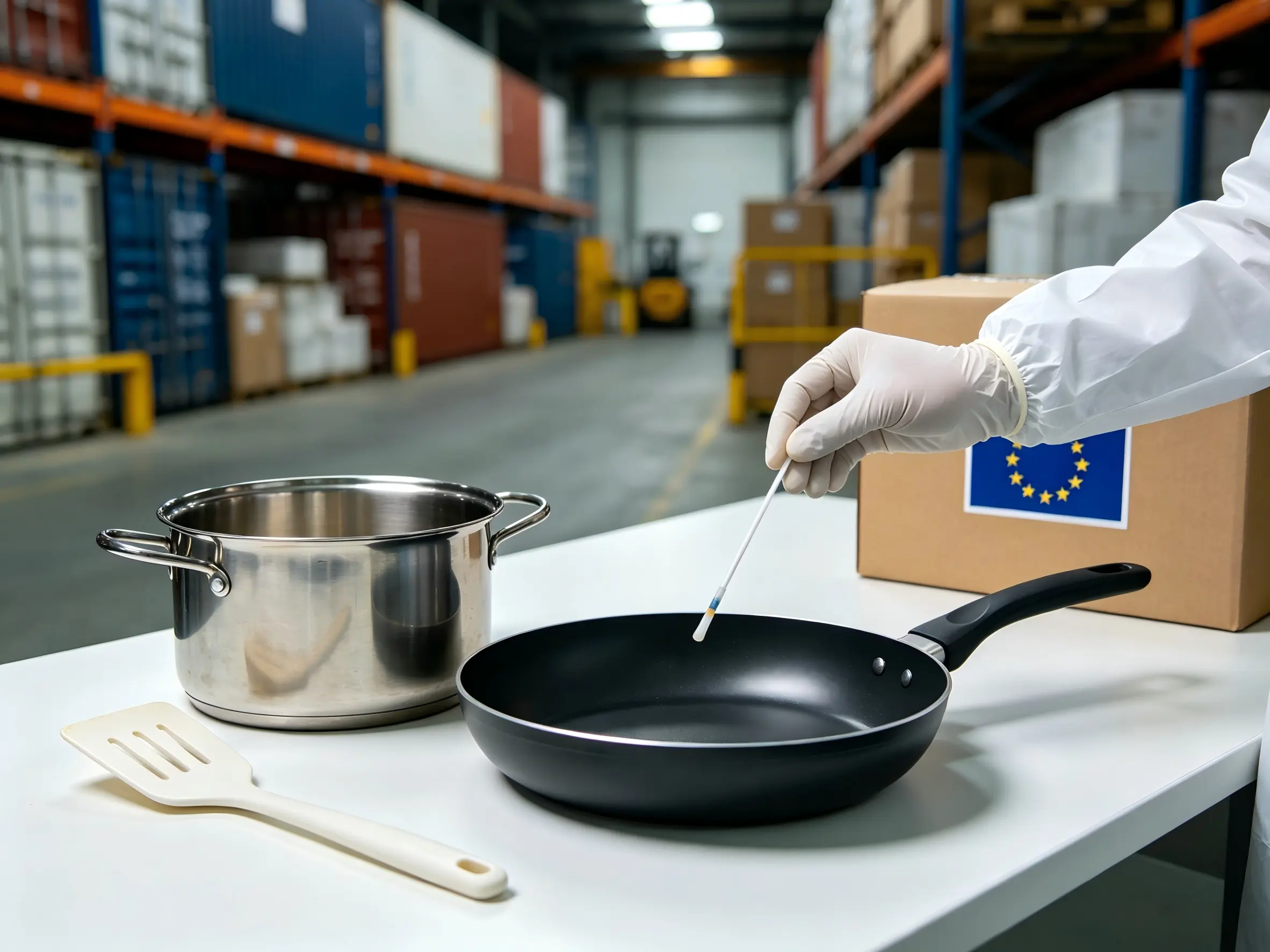
EU food contact materials compliance means anything that touches food must be safe. That includes cookware, utensils, containers, and even coatings.
The main rule behind it is Regulation (EC) No 1935/2004. This is the “big umbrella” law in the EU.
It basically says:
- No harmful substances can migrate into food
- Materials must be tested and controlled
- Products must be traceable and documented
This covers things like:
- Stainless steel cookware
- Aluminum pots and pans
- Plastic kitchen tools
- Non-stick coatings
- Glass and ceramic items
If it touches food, it’s in the scope.
Why It Matters for Kitchenware Importers
Here’s the reality.
If you don’t meet EU food contact rules, your goods don’t move.
Common problems include:
- Containers stuck at customs
- Buyers rejecting shipments
- Retailers pulling orders
- Costly recalls or penalties
And in 2026, enforcement is getting more serious. Less paperwork tolerance. More real testing checks.
So now it’s not just about shipping fast. It’s about shipping clean.
Key EU Food Safety Rules for Kitchenware
Core Regulations You Need to Know
You don’t need to memorize every law. But you should know the key ones:
- EU 1935/2004 → basic safety rule
- EU 10/2011 → plastics control
- GMP 2023/2006 → how factories must work
Think of them as:
- “Is it safe?”
- “What’s inside it?”
- “How is it made?”
Simple logic, strict execution.
What Buyers Expect in Real Life
In practice, EU buyers want:
- Passed migration tests
- Safe raw materials
- Full traceability
- Proper factory process control
No guesswork. No “trust me bro” quality.
What’s Changing in 2026
A few clear trends:
- More random customs checks
- More demand for lab reports
- Digital tracking of compliance documents
- Less tolerance for missing paperwork
In short: more control, less flexibility.
Food Contact Materials Testing in Europe
What Gets Tested
This is where most importers get nervous.
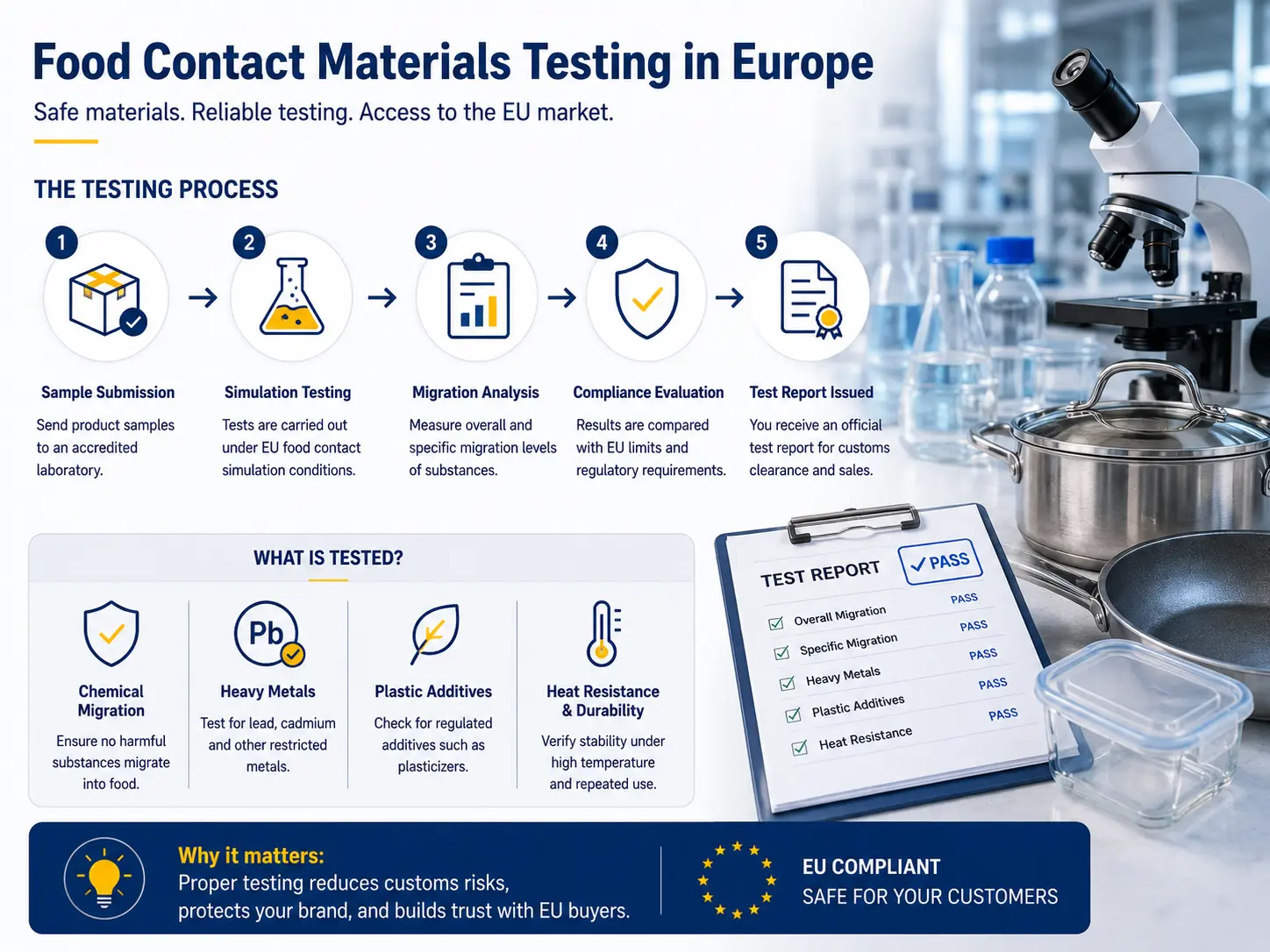
Testing usually covers:
- Heavy metals (like lead, cadmium)
- Chemical migration
- Plastic additives
- Heat resistance
Basically: “Does anything bad leak into food?”
How Testing Works
The flow is pretty standard:
- You send samples
- Lab runs simulation tests
- Migration levels are measured
- Results are checked against EU limits
- You get a report
No report = no real compliance.
Where Things Go Wrong
Most failures come from simple issues:
- Cheap raw materials
- Weak coatings
- Unapproved additives
- Missing supplier data
It’s usually not the test. It’s the sourcing.
LFGB vs EU Regulations for Cookware
The Simple Difference
| Topic | EU Rules | LFGB (Germany) |
| Scope | Europe-wide | Germany |
| Strictness | Standard | Often stricter |
| Usage | General EU market | Premium buyers |
Why This Matters
A lot of buyers mix these up.
In reality:
- EU compliance = minimum requirement
- LFGB = higher standard (often asked in Germany)
If you can pass LFGB, EU is usually not a problem.
Kitchenware Compliance Requirements in the EU
Documents You Must Have
No documents = no entry.
You need:
- Declaration of Compliance
- Lab test reports
- Material breakdown
- Traceability records
Simple, but non-negotiable.
Product Requirements
Your kitchenware must:
- Be food-safe
- Handle heat properly
- Resist corrosion
- Stay stable during use
No weird reactions. No surprises.
Why Suppliers Matter So Much
Here’s the truth many importers learn late:
Compliance starts at the factory.
A solid Chinese kitchenware supplier will:
- Pick safe raw materials
- Control production properly
- Handle testing early
- Prepare export documents correctly
If this step is weak, everything downstream becomes risky.
European Import Safety Standards for Cookware
What EU Buyers Expect
European buyers are quite strict now. They want:
- Full material traceability
- Real lab reports (not copied ones)
- Stable quality across batches
- Clean documentation
No shortcuts here.
Common Import Risks
Things that cause trouble:
- Supplier inconsistency
- Missing certificates
- Poor labeling
- No pre-shipment inspection
Small issues. Big consequences.
How AUSPACE Helps in Practice
From a real-world standpoint, AUSPACE supports importers with:
- Full production control from start to finish
- Pre-shipment inspections with reports
- Coordination of compliance testing
- OEM/ODM customization for EU requirements
- Around 25-day production lead time
The goal is simple: fewer surprises when goods hit Europe.
Plastic and Metal Food Contact Rules in the EU
Plastic Materials
- Strict migration limits under EU 10/2011
- Only approved substances allowed
- Full additive transparency required
Metal Cookware
- Stainless steel must meet alloy safety standards
- Aluminum requires safe surface treatment
- Heavy metal migration must stay within limits
Coatings
- Must be food-safe and stable
- Must pass heat resistance tests
Must avoid harmful chemical migration
Cookware Certification in Europe 2026
What You Usually Need
- EU Declaration of Compliance
- LFGB reports (for Germany)
- Third-party lab testing
Timing
- Standard testing: 7–15 days
- Complex products: longer
Docs usually take longer than tests.
Real Challenges
Importers usually struggle with:
- Changing rules
- Rising testing costs
- Supplier gaps
- Slower customs checks
It’s not one big problem. It’s many small ones.
How Importers Can Stay Safe
Step 1: Pick the Right Supplier
Look for:
- Export experience in Europe
- Strong QC system
- Real compliance cases
Step 2: Test Early
Don’t wait until the end.
Test:
- Raw materials
- Coatings
- Early samples
Step 3: Check Before Shipment
Always:
- Inspect batch quality
- Confirm documents
- Check packaging compliance
Step 4: Work with Full-Service Suppliers
It just makes life easier:
- Less back-and-forth
- Fewer mistakes
- Faster delivery cycles
FAQ: You May Want to Know about EU
What is EU food contact materials compliance?
It is the set of rules ensuring all food-contact products in the EU are safe and do not release harmful substances.
What rules apply in Europe?
Key rules include EU 1935/2004, EU 10/2011, and GMP Regulation 2023/2006.
What gets tested?
Mostly chemical migration, heavy metals, and material stability.
Is LFGB required in the EU?
No, but it is required in Germany and often requested by premium buyers.
How long does certification take?
Usually 7–15 days depending on product complexity.
Can suppliers help with compliance?
Yes. Experienced suppliers manage materials, testing, and documentation to ensure compliance.
Why Partner with AUSPACE for EU-Compliant Kitchenware?
Navigating EU food contact materials compliance can feel overwhelming, especially when regulations, testing requirements, and documentation standards continue to evolve. The good news is that you don’t have to manage everything on your own.
At AUSPACE, we have been helping global kitchenware brands, importers, wholesalers, and retailers source compliant products since 2014. With more than 11 years of industry experience, we understand the challenges businesses face when exporting kitchenware to Europe and other regulated markets.
What makes us different is our one-stop service model. Instead of coordinating with multiple suppliers, testing agencies, and logistics providers, you can manage your entire project through a single partner. From product development and sourcing to manufacturing, quality control, compliance testing support, and final delivery, we help simplify every step of the process.
Our team works closely with customers to ensure products meet EU food safety regulations for kitchenware, including material selection, production monitoring, and documentation preparation. Every order undergoes professional inspection, and we provide detailed reports to help improve transparency and reduce compliance risks.
We also understand that speed matters in today’s market. That’s why we offer a مهلة إنتاج قياسية مدتها 25 يومًا for many kitchenware projects, helping customers respond faster to market opportunities while maintaining product quality.
Whether you are looking for cookware, bakeware, kitchen utensils, food storage solutions, or custom OEM/ODM products, AUSPACE is committed to delivering reliable products, consistent quality, and professional support throughout the entire sourcing journey.
If you’re planning to expand your kitchenware business in Europe and want a trusted partner who understands both manufacturing and compliance, AUSPACE is ready to help. Contact our team today to discuss your next project and discover how we can help you bring safe, compliant, and market-ready kitchenware products to your customers.
الخاتمة
EU food contact rules in 2026 are not getting easier. They are getting tighter. And more “real”.
If you’re importing kitchenware, you can’t treat compliance as paperwork anymore. It’s part of the product itself.
الفهم EU food contact materials compliance helps you avoid delays, fines, and failed shipments. More importantly, it helps you stay trusted in the European market.
At the end of the day, it comes down to this:
good sourcing = fewer problems later.
If you’re working with Europe, it’s worth getting this right from the start.
Partner with AUSPACE now, get more partnership opportunities.

بيري بيان هي أخصائية توريد أدوات المطبخ ودعم المشترين في أوسبيس لأدوات المطبخ، ولديها سنوات في توريد أدوات المطبخ بالجملة في الصين. وهي تساعد المشترين الدوليين في تتبع الطلبات والتواصل مع المصنع واختيار المنتجات حسب الطلب.
وبفضل خبرتها العملية في مجال التجارة، تقدم نصائح عملية حول سلاسة سير عمل التوريد وحل مشاكل سلسلة التوريد. ويربط دعمها المشترين في الخارج بالمصنعين الصينيين الموثوقين، مما يجعلها مرجعاً لتوريد أدوات المطبخ دون أي متاعب.